The Art of Absence: Mastering Negative Space in Your Home Gallery
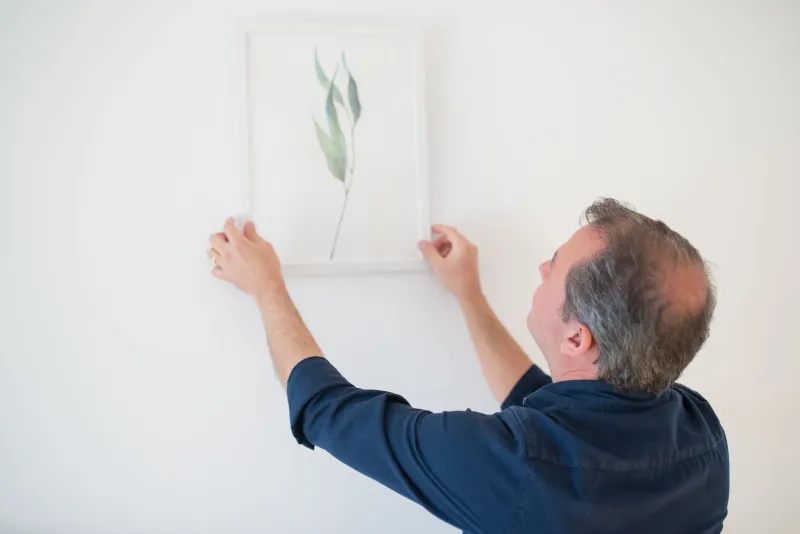
There is a particular kind of collector who enters a room and immediately begins cataloguing available wall space. Every blank expanse becomes a potential site, every empty corner an invitation. It is an understandable impulse — passion for art tends to express itself as accumulation. Yet some of the most compelling private collections in America are defined not by what hangs on the walls, but by what does not.
Negative space, a concept long understood by painters and sculptors, translates with remarkable fidelity to the art of display. The silence between pieces is not wasted real estate. It is the visual equivalent of a held breath — the moment before resolution that gives meaning to everything surrounding it.
Why Restraint Amplifies Impact
Human perception operates through contrast. When a single painting occupies an expansive wall, the eye has nowhere to wander. It settles, studies, and deepens its engagement with the work in ways that a crowded salon-style arrangement rarely permits. Cognitive psychologists refer to this as focal attention — the brain's capacity to fully process a stimulus when it is not competing with adjacent information.
Dr. Marguerite Holloway, a visual perception researcher whose work has been cited in museum installation literature, describes the phenomenon plainly: "Clutter is the enemy of contemplation. When we remove competing stimuli, we don't just see more — we feel more."
For collectors, this has a direct and practical implication. A single extraordinary work given generous breathing room will register more deeply with guests, family members, and the collector themselves than a wall dense with comparable pieces. The art is no longer decoration; it becomes an event.
The Practical Geometry of Spacing
For those accustomed to instinctive hanging decisions, introducing intentional spacing can feel disorienting at first. The following guidelines offer a structural foundation without imposing rigidity.
The 57-Inch Rule, Extended. Museum curators traditionally hang works so their centers align at approximately 57 inches from the floor — average eye level for a standing adult. When applying this standard at home, consider extending the horizontal margins beyond conventional wisdom. Rather than positioning a piece 6 to 8 inches from adjacent works or architectural features, experiment with 18 to 24 inches of clearance. The additional margin transforms the wall into a stage rather than a storage surface.
The One-Third Principle. A useful formula for gallery walls: the total surface area occupied by artwork — frames included — should not exceed one-third of the available wall space. The remaining two-thirds functions as visual silence, allowing the eye to rest and the works to assert themselves individually.
Solitary Placement Zones. Designate at least one wall in each major living space as a single-work zone. Regardless of the room's size or the piece's dimensions, this wall hosts one artwork and nothing else. No adjacent shelving, no flanking sconces that compete for attention. This practice, adopted by numerous minimalist collectors across the country, creates an anchor point that grounds the entire room.
Collectors Who Chose Subtraction
In Portland, Oregon, architect and collector Warren Ashby spent three years acquiring works by West Coast abstract painters before reaching what he describes as "a moment of saturation." His walls, once tightly packed in the tradition of the European salon, had begun to feel oppressive. "I realized I was managing a storage problem, not a collection," he says.
Ashby's response was radical: he rotated more than half his holdings into archival storage and rehung the remainder with expansive spacing. His living room, once home to eleven pieces, now features three. "The works I kept started conversations I'd never had before. Guests would stand in front of a single painting for ten minutes. That never happened when there were eleven of them competing."
A similar transformation took place in the Chicago home of educator and collector Denise Park, whose collection of contemporary fiber art had grown to the point where individual works were effectively invisible. Park engaged an independent curator to help her edit the display, a process she describes as emotionally demanding but ultimately liberating. "Putting something in storage doesn't mean you love it less. It means you respect it enough to give it a proper moment when it's displayed."
Rotation as a Living Practice
One of the most elegant solutions to the tension between a growing collection and disciplined display is systematic rotation. Rather than attempting to show everything simultaneously, collectors who practice rotation treat their walls as a curated exhibition space that evolves on a schedule — seasonally, annually, or in response to specific themes or events.
This approach carries several advantages. Works that have become invisible through familiarity regain their impact after a period in storage. The collector's relationship with each piece deepens as it cycles in and out of daily view. And the home itself feels dynamic, reflecting the collector's ongoing engagement with their holdings rather than a static accumulation.
Practically speaking, rotation requires investment in proper storage — acid-free materials, climate-stable environments, and organized cataloguing systems. Many serious collectors work with art handlers or local fine art storage facilities to maintain pieces between display periods.
The Emotional Challenge of Editing
It would be dishonest to present curatorial restraint as a purely aesthetic exercise. For most collectors, the decision to leave a wall bare — or to move a beloved work into storage — carries genuine emotional weight. Acquisition is often tied to memory: the gallery opening where a piece was discovered, the artist whose studio visit changed a collector's perspective, the anniversary gift that carries meaning beyond its visual qualities.
Acknowledging this emotional dimension is not a weakness; it is a mark of a thoughtful collector. The goal of negative space is not minimalism for its own sake. It is the creation of conditions under which art can be truly experienced rather than merely displayed. When a collector chooses to give one work an entire wall, they are not diminishing the others — they are honoring the one that, in this moment, has the most to say.
The silence between pieces, properly understood, is not emptiness. It is the space where meaning accumulates.