Measured Ambitions: How the Dimensions of Art Shape the Way We Live With It
There is a moment familiar to many collectors — standing in a gallery before a work that stops you cold, only to bring it home and find it somehow diminished. Or, conversely, acquiring a modest-sized piece on a whim and discovering, weeks later, that it has quietly become the emotional center of an entire room. In both cases, the culprit is the same: scale, and the underestimation of its power.
When collectors speak of what draws them to a particular work, they often describe color, subject matter, or the reputation of the artist. Rarely does scale enter the conversation as a primary consideration — yet few qualities exert more influence over how art functions within daily life. Understanding dimension not merely as a logistical concern but as an aesthetic and psychological force is one of the marks of a truly discerning collector.
The Commanding Language of Large-Scale Works
Monumental works speak first. Before the eye has time to settle on brushwork, palette, or composition, the sheer physical presence of a large canvas or sculpture announces itself. This is not accidental. Artists working at grand scale — from the Abstract Expressionists of mid-century New York to contemporary painters commanding gallery walls across Los Angeles and Chicago — have long understood that size is itself a form of rhetoric.
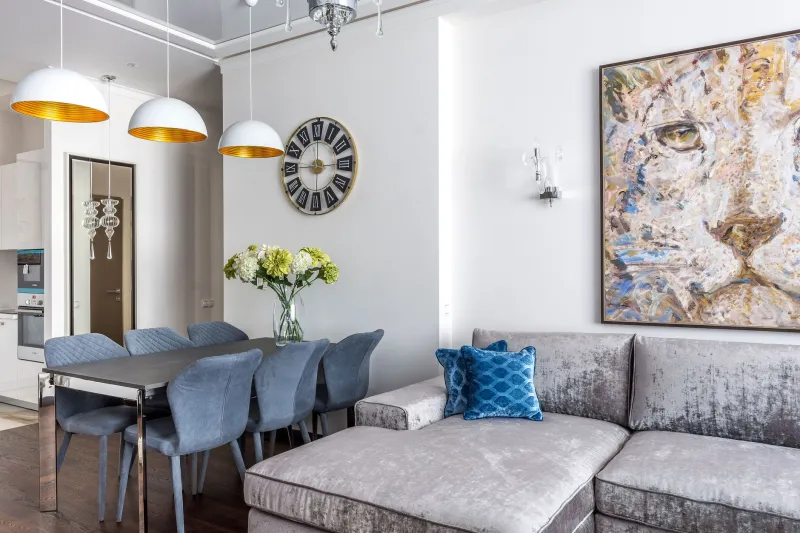
A painting measuring six feet or more in any direction does not merely occupy a wall; it reorganizes the room around itself. Furniture arrangements shift in deference to it. Conversation orients toward it. Guests entering a space encounter it before anything else. For collectors who wish their homes to reflect a certain seriousness of engagement with art, large-scale works offer an immediacy that smaller pieces, however exquisite, simply cannot replicate.
That said, scale without intention is merely volume. A large work placed in a room too small for it does not command — it oppresses. Ceilings feel lower, walls closer, and the work itself can appear trapped rather than liberated. The practical calculus here involves not only square footage but ceiling height, natural light sources, and the visual weight of surrounding furnishings. A grand abstract work may thrive in a loft-style open plan and feel suffocating in a traditionally proportioned dining room.
The Quiet Authority of Intimate Dimensions
At the opposite end of the spectrum, small-scale works carry their own distinct power — one that is frequently undervalued in contemporary collecting culture, where social media tends to reward spectacle over subtlety. A six-inch oil study, a delicate work on paper, a small bronze casting: these objects invite proximity. They ask the viewer to lean in, to bring the eye close, to enter into a kind of private dialogue that larger works rarely permit.
This intimacy is not a consolation prize for collectors working with limited wall space. It is a fundamentally different mode of engagement. Historically, small-scale works — cabinet paintings, miniatures, intimate drawings — were among the most prized objects in private collections precisely because they demanded and rewarded sustained attention. They were meant to be held, examined closely, and returned to repeatedly.
For collectors in urban environments, where living spaces in cities like New York, San Francisco, and Boston often impose strict spatial constraints, small-scale works offer an opportunity to build collections of remarkable depth and quality without the architectural requirements that large works demand. A thoughtfully assembled wall of smaller pieces can, in fact, generate a visual richness that a single large canvas cannot achieve alone.
Emotional Resonance Across the Spectrum
Beyond spatial logistics, scale carries distinct emotional frequencies. Research in environmental psychology suggests that large visual fields tend to produce feelings of awe, expansiveness, and sometimes mild anxiety — responses that can be deeply pleasurable in the right context but exhausting if encountered daily in a living or sleeping space. Smaller works, by contrast, tend to generate feelings of intimacy, comfort, and personal connection.
This has practical implications for room-by-room collecting decisions. A monumental abstract work may be precisely the right choice for an entry hall or a dedicated study — spaces where a powerful first impression or a concentrated moment of engagement is desirable. That same work placed above a bed, where the subconscious association should lean toward rest and calm, may subtly undermine the quality of sleep and relaxation the room is meant to support.
Considerate collectors think of scale as part of a broader conversation between the artwork, the architecture, and the human body moving through both. A piece that makes you feel small in a deliberate, awe-inspiring way is doing something very different from one that simply overwhelms because it was chosen without regard for its surroundings.
Proportion, Proportion, Proportion
One of the most reliable principles in placing art is the concept of visual proportion — the relationship between the dimensions of the work and the dimensions of the surface or space it occupies. A general guideline embraced by many interior designers and experienced collectors suggests that artwork should occupy between fifty and seventy-five percent of the wall space above a given piece of furniture, whether a sofa, credenza, or bed frame. This is not a rigid rule but a useful starting point for understanding why certain placements feel balanced and others do not.
The same logic applies when considering multiple works together. A gallery wall composed entirely of similar-sized pieces can feel static and uninspired, while a thoughtfully varied arrangement — anchored by one or two larger works and complemented by smaller pieces — tends to create the kind of dynamic visual conversation that makes a collection feel alive rather than merely displayed.
Collecting Satisfaction Over Time
Perhaps the most overlooked dimension of scale is its relationship to long-term collecting satisfaction. Works that initially seem appropriately sized can, over years, begin to feel either too assertive or too easily overlooked as tastes evolve and living circumstances change. Collectors who have moved from smaller apartments to larger homes, or who have watched their collections grow from a handful of pieces to dozens, often report that their understanding of scale has shifted dramatically with experience.
The wisest approach is to think of scale not as a fixed attribute to be matched against a fixed space, but as a dynamic quality that will interact differently with your life at different stages. Buying a work because it fits a specific wall is a short-term solution; buying a work because its scale feels right to your eye, your sensibility, and your long-term vision for a collection is a far more durable strategy.
At Artag Gallery, we believe that the most satisfying collections are built on exactly this kind of considered attention — to dimension as much as to image, to presence as much as to provenance. When you stand before a work and feel, in your body as much as your mind, that it is the right size, you are experiencing one of the quieter pleasures of collecting: the recognition that art, at its best, is always in conversation with the human scale of the life lived around it.