Art as Icebreaker: Curating a Home Where Every Piece Invites a Story
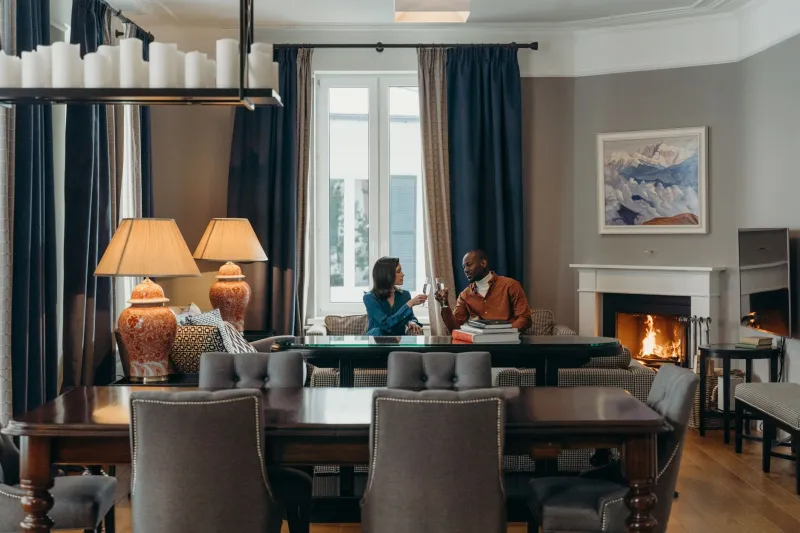
There is a particular kind of silence that settles over a dinner party the moment introductions have been made but the wine has not yet loosened anyone's reserve. Hosts know it well. It is the silence that interior designer Margaret Holloway of Chicago describes as "the gap between arrival and belonging" — and she has spent the better part of two decades helping clients fill it, not with small talk, but with art.
"When someone walks into a room and their eyes land on something genuinely unexpected," Holloway explains, "the question forms before they even realize it. They turn to the person nearest them and say, 'What do you think that is?' That's the beginning of a real conversation."
The idea that artwork can serve a social function — that it can act as a catalyst rather than a backdrop — is gaining traction among American collectors who think carefully about where they live and how they entertain. It represents a meaningful shift in how many people approach the act of collecting: less as an exercise in taste-signaling and more as an investment in the quality of daily human experience.
The Psychology Behind the Pause
Psychologists who study social behavior have long understood that shared objects of attention reduce interpersonal anxiety. When two strangers focus on the same external stimulus — a piece of music, a view, a work of art — the cognitive load of self-presentation momentarily lifts. The artwork, in effect, does the social labor.
Dr. Simone Park, a behavioral researcher based in Boston who has consulted with cultural institutions on visitor engagement, notes that visual art is particularly effective in this regard because it resists single, definitive interpretation. "A photograph of a recognizable landmark tells you what it is," she says. "But an abstract canvas, or a figurative work with an ambiguous emotional register, leaves room for the viewer to project. And when people project, they reveal something true about themselves — which is exactly what connection requires."
This interpretive openness is something collectors can deliberately seek out. Works that pose a question rather than announce an answer tend to generate more sustained dialogue. A landscape rendered in an unexpected palette, a portrait whose subject holds an unreadable expression, a sculpture assembled from materials that seem at odds with one another — these are the pieces that keep guests standing in front of them, talking.
Placement as Intention
Knowing which works invite dialogue is only half the equation. Where those works live within a home matters enormously. Collectors and designers who have thought seriously about social curation tend to follow a few guiding principles.
First, the most conversation-worthy pieces belong in transitional and gathering spaces — entryways, living rooms, the walls visible from a dining table — rather than sequestered in private rooms or hallways that guests pass through too quickly to register. "The entry hall is undervalued," says San Francisco-based collector and architect David Reyes. "It's the first thing a guest sees and the last thing they remember. A single strong work there sets the entire emotional tone of an evening."
Second, scale matters in relation to the social dynamic you want to create. A large-format work commands attention and tends to draw a group together physically, which naturally generates collective discussion. Smaller works, displayed in clusters or salon-style arrangements, encourage more intimate, one-on-one exchanges as guests move closer to examine individual pieces.
Third, and perhaps most importantly, the work must be genuinely meaningful to the collector. Holloway is emphatic on this point. "Guests can feel when something was chosen because it was a safe investment or because someone told the owner it was important," she says. "They can also feel when something was chosen because it moved the person who bought it. That authenticity is what gives people permission to respond honestly."
When Art Isolates Rather Than Connects
Not every work that provokes a reaction fosters connection. There is a meaningful distinction between art that challenges and art that alienates — and collectors who entertain regularly would do well to understand it.
Work that is confrontational in a way that feels aggressive or that requires specialized knowledge to access can inadvertently make guests feel inadequate or excluded. The goal is not to display one's sophistication but to create shared ground. "I've been in homes where the art felt like a test," admits New York-based collector Priya Anand. "Where you sensed that the wrong response would reveal you as someone who didn't belong. That's the opposite of hospitality."
Anand's own collection, which spans works by emerging American artists alongside a few carefully chosen historical pieces, is deliberately assembled with this in mind. "I want people to feel curious, not intimidated. I want them to ask questions without worrying that the question itself is embarrassing." She has found that works with visible process — where the hand of the artist is evident, where materials are raw or layered in ways that invite inquiry into how something was made — tend to democratize engagement. Everyone, regardless of their art background, can ask how.
Curating for the Room, Not Just the Wall
The collectors and designers who have most successfully transformed their homes into spaces of genuine social warmth speak about art curation the way a thoughtful host thinks about a guest list: with attention to how different elements will interact, what energy each brings, and what kind of exchange becomes possible when they are placed in proximity.
This means considering not just individual works but the relationships between them — how a vibrant abstract in one corner speaks to a more restrained figurative piece across the room, creating a visual tension that mirrors the productive tension of good conversation. It means thinking about the sightlines from a seated position, since most meaningful exchanges happen when people are settled rather than standing. And it means leaving room for the unexpected: the piece that surprises even the collector, the work whose meaning continues to evolve.
"The best art in a home is never fully resolved," says Holloway. "It keeps offering something new, which means it keeps offering something to talk about."
An Investment in Experience
For collectors who measure the value of their acquisitions strictly in financial terms, the social dimension of art may seem peripheral. But for those who understand collecting as a practice woven into the texture of a life — into the evenings spent at home, the friendships deepened over a meal, the unexpected intimacy that develops when two people find themselves genuinely moved by the same thing — it is central.
Art, at its most alive, is never static. It changes with the light, with the company, with the mood of the room. A piece that seemed purely aesthetic when purchased reveals an emotional depth when a guest stands before it and says, quietly, that it reminds them of something they lost. In that moment, the work has done something that no investment portfolio can replicate. It has made two people less alone.
That, perhaps, is the most compelling argument for collecting thoughtfully: not the appreciation of value over time, but the quality of the conversations that happen in its presence.