Living With the Uncomfortable: How Collectors Are Making Room for Art That Challenges
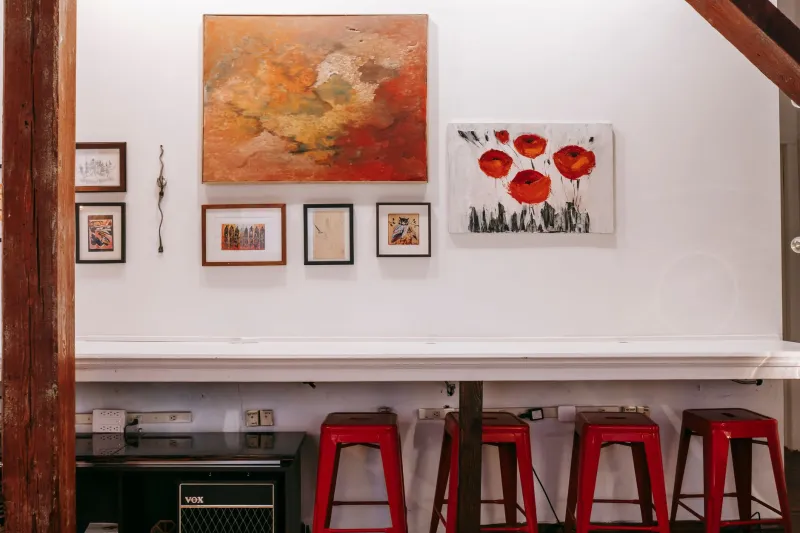
There is a particular kind of silence that falls over a room when a guest notices a painting they were not expecting. It is not the silence of embarrassment, nor entirely of confusion. It is the silence of genuine encounter — the pause before a person decides what they actually think. For collectors who have chosen to live with challenging, provocative, or politically charged artwork, that pause is precisely the point.
Across the United States, a growing number of art collectors are moving beyond the decorative and into the deliberately uncomfortable. They are acquiring work that raises questions about race, gender, mortality, religion, and power — and then hanging it above the fireplace, positioning it at the end of a hallway, or placing it where morning light will illuminate it first. The decision is rarely impulsive. It is, in almost every case, deeply intentional.
The Psychology of Owning What Disturbs You
Dr. Miriam Ochsner, a cultural psychologist based in Chicago who consults with private collectors, describes the act of living with challenging art as a form of sustained intellectual commitment. "When you purchase a piece that makes you uncomfortable, you are essentially agreeing to sit with that discomfort indefinitely," she explains. "Most people are conditioned to resolve tension quickly. Collectors who embrace difficult work are training themselves to tolerate ambiguity — and that has real psychological benefits."
Ochsner's observation aligns with what many experienced collectors describe in their own language. Patricia Wren, a Boston-based collector who has spent two decades acquiring work that she describes as "socially inconvenient," puts it more plainly: "I don't want my home to be a place where everything is already decided. I want it to be a place where thinking is still happening."
Wren's collection includes a large-scale figurative painting by a contemporary Black American artist that depicts a scene of historical violence with unflinching clarity. It hangs in her dining room. "People notice it immediately," she says. "Some are moved. Some are disturbed. Very few are neutral. And I think that's exactly what art is supposed to do."
Selecting the Work: Intention Over Impulse
The distinction between collecting provocative art thoughtfully and acquiring it recklessly is significant. Experienced collectors and advisors consistently emphasize that the most successful acquisitions in this category are driven by genuine engagement with the work, not by the desire to appear transgressive.
Marcus Bell, a New York-based art advisor who works with emerging and mid-career artists, counsels his clients to ask a specific question before committing to any piece that gives them pause: Does this discomfort come from the work itself, or from what I imagine others will think of it? "There's a meaningful difference," he says. "If the art genuinely challenges your assumptions or forces you to reckon with something real, that's worth pursuing. If you're primarily worried about your mother-in-law's reaction at Thanksgiving, that's a different conversation."
Bell also encourages collectors to research the artist's intent thoroughly — reading interviews, attending studio visits where possible, and understanding the cultural and historical context from which the work emerges. This groundwork, he argues, gives collectors the language and confidence to stand behind their choices when the inevitable questions arise.
Placement as Editorial Decision
Where you position a challenging piece within your home communicates as much as the work itself. A confrontational image placed in a formal entryway signals something different than the same work tucked into a private study. Neither choice is inherently correct, but both are deliberate.
Interior designers who specialize in art-forward homes often speak of "conversation architecture" — the way that placement shapes the terms under which a piece will be encountered. A work that deals with themes of vulnerability or grief, for instance, may be most honestly positioned in a quieter, more intimate space, where viewers have room to respond privately before being asked to articulate anything aloud.
James Kowalski, a collector in Minneapolis who owns a significant body of work addressing environmental devastation, has arranged his collection so that the most demanding pieces are encountered gradually. "You don't walk into my house and get hit with everything at once," he explains. "There's a progression. By the time you reach the most difficult work, you've already had a few smaller encounters that prepared you for it. It's like building trust with a viewer before asking them to go somewhere hard."
Hosting the Conversation Without Moderating It
One of the most common anxieties among collectors considering challenging acquisitions is the social dimension: how do you host a dinner party, a holiday gathering, or a casual Sunday afternoon when your walls are making a statement that not everyone will welcome?
The answer, according to both collectors and social psychologists, lies in the difference between framing and defending. A collector who feels compelled to justify every acquisition at every gathering will exhaust both themselves and their guests. A collector who can offer context — briefly, warmly, without apology — creates space for genuine exchange.
"I've learned to say very little initially," says Wren. "I let the work speak first. If someone wants to talk about it, I'm happy to share what drew me to it. But I don't explain myself preemptively. That would suggest I think I've done something wrong, and I don't."
Bell recommends that collectors prepare one or two sentences about each significant piece — not a defense, but an invitation. Something as simple as: This was made in response to the 2020 protests, and I found the artist's approach to memory and grief really compelling. That framing opens a door without pushing anyone through it.
Emotional Resilience and the Long Game
Living with challenging art is not a static experience. A piece that disturbed you when you first acquired it may, over years, become deeply familiar — even comforting in its consistency. Conversely, work that initially seemed merely interesting can grow more difficult as your own life experience accumulates around it.
Kowalski describes this evolution as one of the quiet rewards of serious collecting. "There's a painting in my bedroom that I've owned for eleven years. My relationship to it has changed completely. When I bought it, it felt like an accusation. Now it feels more like a witness. The work didn't change. I did."
This capacity for a single artwork to sustain multiple, shifting relationships over time is, for many collectors, the strongest argument for acquiring work that resists easy resolution. Comfortable art, by its nature, has a ceiling. Art that challenges tends not to.
A Space That Thinks
The home of a thoughtful collector is, at its best, a curated environment for living and thinking simultaneously. When challenging work is chosen with care, positioned with intention, and held with confidence, it does not destabilize a household. It enriches it — providing the friction that keeps both mind and eye engaged.
The collectors who do this most successfully share a common quality: they have made peace with the fact that not every guest will understand, not every reaction will be positive, and not every conversation will resolve neatly. They have decided, in essence, that the alternative — a home filled only with work that pleases everyone — is a far greater loss.
As Wren summarizes: "Art that everyone loves is fine. Art that makes you think, that makes your guests uncomfortable, that stays with you at three in the morning — that's a collection. There's a difference."
For collectors ready to explore work that moves beyond the decorative and into the genuinely challenging, Artag Gallery's curated collections offer a considered starting point — artwork selected not merely for beauty, but for the depth of conversation it is capable of sustaining.