The Power of Pause: How Intentional Empty Space Transforms Your Art Collection
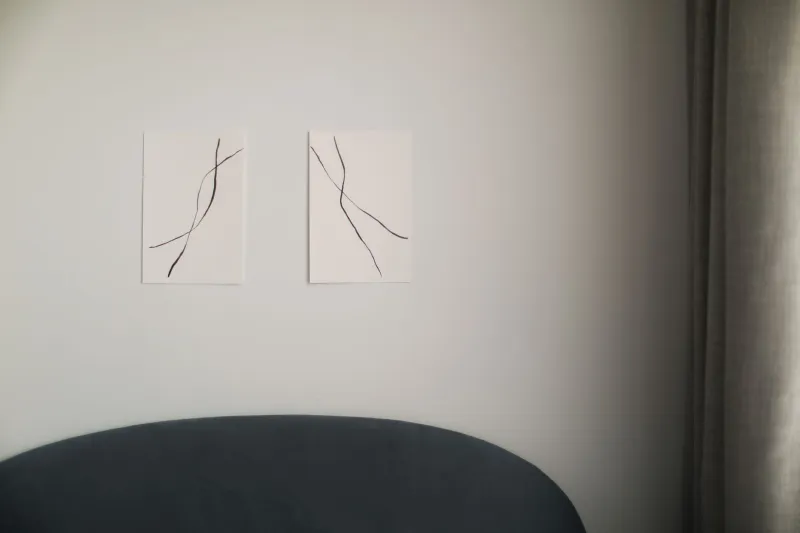
There is a particular kind of collector who, upon acquiring a new piece, immediately begins calculating where it will fit among the others. Walls become puzzles. Every inch of plaster feels like an opportunity. Yet some of the most compelling private collections in the United States share a counterintuitive quality: they are defined not only by what hangs on their walls, but by what does not.
Negative space — the deliberate absence of imagery, color, or object — is among the most powerful tools available to any collector or interior designer. Understanding how to wield it separates a room that feels curated from one that merely feels full.
What Curators Have Always Known
Visit any major American art institution — the Art Institute of Chicago, the Museum of Fine Arts in Boston, or the galleries at the Whitney Museum of American Art in New York — and you will notice that the walls are rarely saturated. Paintings breathe. Sculptures stand in generous clearings. This is not a consequence of limited acquisitions; these institutions hold far more work than they ever display simultaneously. The spacing is a deliberate editorial choice.
Museum curators understand that the eye requires rest. When a viewer's gaze moves from one work to another, the transition across neutral wall space serves as a kind of visual palate cleanser. It allows the brain to process what it has just encountered before committing to what comes next. This principle does not lose its validity simply because the setting changes from an institution to a private home.
For collectors building personal galleries in their residences, adopting this curatorial mindset requires a meaningful shift in perspective. The goal is not to justify every purchase by finding it a home on a wall. The goal is to give each work the conditions it needs to communicate fully.
The Psychological Case for Restraint
Research in environmental psychology consistently demonstrates that visual clutter elevates cognitive load — the mental effort required to process a space. When walls are overcrowded, viewers tend to experience a diffuse, unfocused engagement with individual works. Nothing commands sustained attention because everything competes for it simultaneously.
Contrast this with the experience of entering a room where a single large-format painting occupies an otherwise bare expanse of wall. The eye has no choice but to settle. The mind follows. The work earns the kind of extended, contemplative viewing that its creator almost certainly intended.
This dynamic applies equally to smaller-scale works. A modest oil painting displayed in generous isolation can project a presence entirely disproportionate to its physical dimensions. The surrounding emptiness does not diminish it — it elevates it, framing the work in a way that no gilded border ever could.
Practical Principles for American Living Spaces
American homes present specific architectural realities that influence how negative space can be deployed. Open floor plans, which remain prevalent in contemporary residential design across the country, tend to create expansive, uninterrupted wall surfaces. These are extraordinary opportunities that are frequently squandered through overhanging.
A few foundational principles can guide collectors toward more intentional arrangements:
Treat the wall as part of the composition. When determining placement, consider the painted or textured surface itself as a visual element. A warm cream or neutral gray wall does not merely serve as background — it participates actively in how color and form within the artwork are perceived. Allow the wall to do its share of the work.
Establish a minimum clearance standard. As a general guideline, works displayed in a gallery-style arrangement benefit from at least twelve to eighteen inches of unoccupied space between frames, and considerably more between works of different scales or visual weights. This is not a rigid rule, but a useful starting point for collectors recalibrating after years of instinctive hanging.
Resist the impulse to fill newly emptied space. When a collector removes a work for cleaning, sale, or relocation, the instinct is often to replace it immediately. Instead, allow the vacancy to persist for several days. Live with it. Observe how the room feels. Frequently, collectors discover that the absence itself improves the overall composition in ways they had not anticipated.
Anchor, do not scatter. Rather than distributing a collection evenly across every available surface, consider concentrating works in deliberate groupings separated by substantial negative space. This approach creates a rhythm within a room — moments of visual intensity followed by intervals of calm — that mirrors the pacing of an expertly designed gallery exhibition.
When Less Truly Becomes More
The concept of restraint runs somewhat against the grain of American collecting culture, where acquisition is often celebrated and abundance is associated with success. Building a collection, however, is not the same as assembling an inventory. The finest collections are edited as rigorously as they are expanded.
Some collectors find it useful to think in terms of rotating displays. Rather than attempting to show every acquired work simultaneously, they maintain a portion of their collection in archival storage, cycling pieces in and out of active display on a seasonal or annual basis. This practice not only preserves the integrity of individual works from prolonged light exposure, but ensures that what remains on view retains its capacity to surprise and engage.
For those who have already committed to densely hung arrangements, the process of editing need not be abrupt or wholesale. Begin with a single room. Select the two or three works you consider most significant within that space and remove everything else temporarily. Observe the effect. Then reintroduce pieces selectively, pausing after each addition to assess whether the overall composition has been strengthened or diluted.
The Art of Knowing When to Stop
There is a moment in the arrangement of any collection when the work is complete — not because the walls are full, but because the space has achieved a coherent, resonant balance. Recognizing that moment, and resisting the temptation to push past it, is perhaps the most sophisticated skill a collector can develop.
Negative space is not emptiness. It is not indecision or incompletion. It is an active, considered choice — a declaration that each work on display deserves the full attention of everyone who encounters it. In this sense, what you leave blank on your walls is not an absence at all. It is, in its own right, a statement of curatorial intent.
The collectors who understand this tend to live with art differently. They notice more. They linger longer. And the works they have chosen, given room to breathe, seem to speak with a clarity that a crowded wall can never quite achieve.