Art Without Walls: The Collector's Reckoning With More Than Space Can Hold
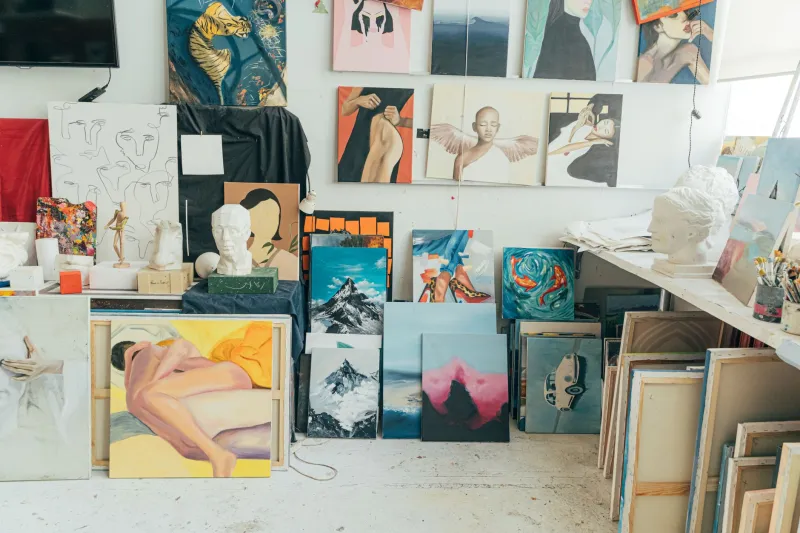
There is a particular kind of silence that settles over a collector when they bring home a new piece and realize, standing in the doorway, that there is nowhere left to hang it. The walls are spoken for. The shelves are committed. The corner that once seemed generous now belongs to a sculpture acquired two seasons ago. This moment—equal parts triumph and reckoning—is one of the most honest experiences collecting has to offer.
It is also one of the least discussed.
The Acquisition Impulse and Its Consequences
Collecting art is, at its core, an act of sustained desire. Each work represents a moment of recognition—a visual conversation that felt too important to walk away from. American collectors, in particular, tend to build their holdings incrementally, often beginning with a single meaningful piece and expanding outward in ways that feel organic rather than planned. The result, over years or even decades, is a collection that has grown faster than the architecture surrounding it.
This is not a failure of discipline. It is, in many respects, evidence of genuine engagement. The collector who finds themselves overwhelmed by their own holdings has been paying attention—to galleries, to art fairs, to the work of emerging artists, to estate sales and online platforms that surface unexpected discoveries at unexpected hours. Passion, when left unchecked, fills closets.
But the closet, as any seasoned collector will tell you, is where art goes to be forgotten. And forgetting is the one outcome that runs contrary to everything collecting is meant to accomplish.
What Stored Art Reveals About Your Values
Before addressing the practical question of what to do with overflow, it is worth sitting with the more uncomfortable question of why the overflow exists. A collection in storage is a collection of deferred decisions. Each piece waiting in a flat file drawer or leaning against a basement wall represents a choice that was made at the moment of purchase but never fully completed.
Asking why certain works remain unhung often surfaces surprising answers. Sometimes a piece was acquired impulsively, driven more by the energy of an opening or the persuasion of a dealer than by genuine conviction. Other times, a work sits in storage because it challenges the collector in ways they have not yet resolved—its scale is difficult, its subject matter unsettling, its palette at odds with everything else in the home. These are not reasons to sell. They are invitations to look more carefully.
Storage, viewed through this lens, becomes less a logistical problem and more a diagnostic tool. The works you keep but never display are telling you something about the edges of your own taste.
Rotation as Curatorial Practice
One of the most effective—and underutilized—strategies available to collectors with limited wall space is the deliberate rotation of works on display. Rather than treating a hanging arrangement as permanent, consider approaching it the way a museum treats its permanent collection: with seasonal or thematic reinstallations that bring different works forward and allow others to rest.
This approach requires a shift in perspective. The wall is not a repository; it is a stage. Works enter and exit. A painting that felt out of place last year may, after a period in storage, return with renewed clarity. The collector's eye changes. The room changes. A piece that once competed awkwardly with its neighbors may find, upon reinstallation, that it now anchors an entire wall.
Practically speaking, rotation works best when collections are catalogued with enough detail to make retrieval straightforward. A simple spreadsheet noting dimensions, medium, location, and the last date a work was displayed can transform what feels like a chaotic accumulation into a manageable, living archive. Digital tools—including several platforms designed specifically for private collectors—can further streamline this process, allowing you to visualize arrangements before a single nail is moved.
Professional Storage: A Serious Option for Serious Collectors
For collections that have grown beyond what domestic rotation can accommodate, professional art storage facilities offer climate-controlled, security-monitored environments designed to preserve works across a range of media. In major US cities, specialized art storage companies provide services that go well beyond a standard storage unit—offering archival-quality racking, regular condition reporting, and in some cases, white-glove retrieval for collectors who wish to view or loan individual pieces.
The cost is not negligible, and it is worth factoring storage expenses into the overall economics of collecting. A work that appreciates in value while housed in proper conditions is a different proposition from one that deteriorates in an uncontrolled environment. For collectors who take the long view—who acquire with both passion and intention—professional storage is less an extravagance than an investment in the integrity of the collection itself.
Lending, Donating, and the Art of Letting Go
Not every solution involves holding on. Many collectors find genuine satisfaction in lending works to institutions—universities, hospitals, corporate lobbies, and community arts organizations frequently welcome loans that bring art into public view while relieving the collector of the burden of display. These arrangements can be informal or formalized through loan agreements, and they carry the added benefit of keeping works actively seen rather than passively stored.
For pieces that no longer resonate, or that represent earlier, less developed stages of a collector's taste, thoughtful deaccessioning is a legitimate and often liberating choice. Donating to a museum or arts organization, selling through a reputable secondary market platform, or gifting to a younger collector just beginning their own journey are all ways of returning a work to circulation—where it belongs.
The act of releasing a piece, when undertaken deliberately, can clarify what remains. Collections that have been edited tend to feel more coherent, more intentional, and ultimately more personal than those that have simply accumulated.
The Emotional Weight of Art in Waiting
There is something quietly melancholy about a beautiful work of art that no one is looking at. Art exists in relationship—between the object and the viewer, between the work and the space it inhabits. A painting in a closet is, in a sense, incomplete. It is waiting for the act of attention that gives it meaning.
This is not a reason to feel guilty about storage. It is a reason to take it seriously. The collector who maintains an active awareness of what is stored—who revisits, reconsiders, and reintroduces works into the living environment—honors both the art and the impulse that led them to acquire it.
The walls, after all, are not the limit of a collection. They are simply its most visible expression. What lies beyond them, in flat files and climate-controlled vaults and carefully wrapped stacks, is the fuller picture of who a collector is and what they have chosen to care about. Tending to that fuller picture—with honesty, with strategy, and with a willingness to make difficult decisions—is the work that separates a thoughtful collection from a crowded one.