Behind the Canvas: What Artist Studios Reveal About the Work You Collect
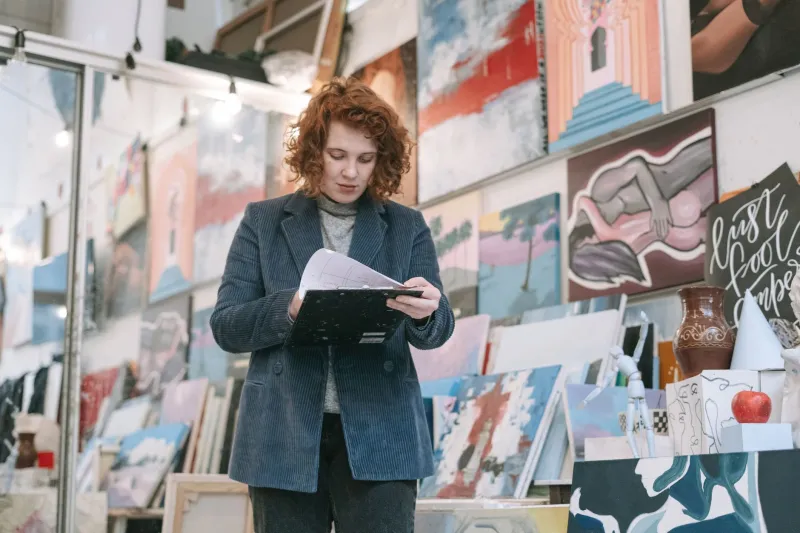
When a collector hangs a painting above a mantle or positions a sculpture in a sunlit corner, they are living with the residue of an entire creative ecosystem—one that began long before stretcher bars were assembled or clay was fired. The studio, that often-overlooked origin point, is where the true biography of an artwork is written. For collectors who care about meaning as much as aesthetics, understanding that space changes everything.
Artag Gallery invited several working artists across the United States to open their studio doors—physically and figuratively—so that collectors might glimpse the unglamorous, generative reality behind the polished surfaces they admire.
The Desert Light of New Mexico: A Painter's Sanctuary
Outside Santa Fe, painter Marguerite Hollins works in a converted adobe structure that has, over two decades, accumulated the geological strata of her practice. Tubes of cadmium and raw umber share shelves with geological survey maps, dried wildflowers, and stacks of art-historical monographs whose spines have long since faded in the high-altitude sun.
"The light here is genuinely unlike anything I encountered when I worked in Chicago," Hollins explains, gesturing toward a north-facing skylight that floods her canvases with what she calls "honest light"—cool, consistent, and unforgiving. Her large-format oils, which have appeared in collections from Houston to Seattle, carry a particular luminosity that she attributes directly to the quality of illumination she has cultivated in this space over years of careful adjustment.
For collectors who own her work, this context is revelatory. The warm ochres and dusty mauves that feel so deliberate on a gallery wall are, in fact, the direct visual vocabulary of the Sangre de Cristo foothills visible through her studio window. The environment did not merely inspire the work—it authored it alongside her.
Brooklyn to the Bronx: Sculpture in an Urban Industrial Space
Not every studio is a pastoral retreat. In the South Bronx, sculptor Darnell Vickers operates out of a former machine shop where the floor still bears the oil stains of its industrial past. The 4,000-square-foot space is loud, dusty, and—by almost any conventional measure—chaotic. It is also, Vickers insists, precisely what his practice requires.
His large-scale steel and reclaimed-wood assemblages draw directly from the neighborhood's layered industrial history. Salvaged I-beams sourced from demolition sites a few blocks away appear in finished pieces that have been acquired by major institutional collectors and discerning private buyers alike. "People sometimes ask me why I don't move somewhere quieter, more comfortable," he says, pausing to wipe steel dust from his forearms. "But this noise, this material—it's the work. You can't separate them."
When a collector acquires one of Vickers' pieces, they are, in a very real sense, acquiring a fragment of urban America at a particular historical moment. The studio is not background; it is content.
The Home Studio: Digital Creation in Suburban Ohio
The mythology of the artist's studio conjures images of vast, paint-streaked lofts. The reality, for a growing number of contemporary practitioners, is considerably more modest. Digital artist and illustrator Priya Sundaram works from a spare bedroom in her Columbus, Ohio home, surrounded by dual monitors, a drawing tablet, and a meticulously organized filing system for hard drives.
Her work—intricate, algorithmically informed illustrations that have been licensed, printed, and sold as limited-edition fine art prints across the country—emerges from a space that looks, at first glance, indistinguishable from any home office. Yet the precision of her environment reflects the precision of her practice. "Every element in here is intentional," she notes. "The ergonomics, the monitor calibration, the acoustic panels. This space is engineered for focus."
For collectors accustomed to imagining artists surrounded by physical media, Sundaram's studio offers an important recalibration. The digital image is no less the product of sustained, disciplined labor—it simply unfolds in a different kind of space.
What the Studio Tells the Collector
These three studios—a sun-drenched adobe in the Southwest, a thunderous industrial loft in the Northeast, a quiet suburban room in the Midwest—share something essential: each is a direct extension of the artist's creative sensibility, and each leaves its fingerprints on every piece that departs from it.
For collectors, studio awareness offers several meaningful advantages.
Provenance enriched by process. Understanding where and how a work was made deepens its provenance beyond simple ownership history. A collector who knows that a particular canvas was produced during an artist's residency in a coastal Maine studio, or during a period of intense personal transition in a cramped Brooklyn apartment, possesses a richer interpretive frame for that work.
Informed acquisition decisions. Artists whose studios reflect sustained, organized, and intentional practice tend to produce bodies of work with internal coherence—qualities that matter enormously to long-term collectors building thematically or stylistically unified collections.
Authentic connection. The art market can feel abstract and transactional. Studio knowledge humanizes it. When collectors understand the physical and psychological conditions under which work is made, they are purchasing not just an object but a relationship with a creative life.
Seeking Access: How Collectors Can Engage
Many American artists welcome studio visits, particularly from serious collectors. Open studio events—common in cities like Los Angeles, New York, Chicago, and Portland—offer structured opportunities to observe working environments firsthand. Artist residency programs frequently host public tours. Gallery relationships, too, can facilitate introductions.
For those unable to travel, an increasing number of artists document their studios through video walkthroughs, process journals, and social media archives. While these formats cannot replicate the sensory experience of standing in a working space, they offer meaningful access to the conditions that shape creative production.
Artag Gallery encourages collectors at every level to look beyond the finished surface and ask where a work was born. The answer, more often than not, transforms how the piece is understood—and how it is loved.